








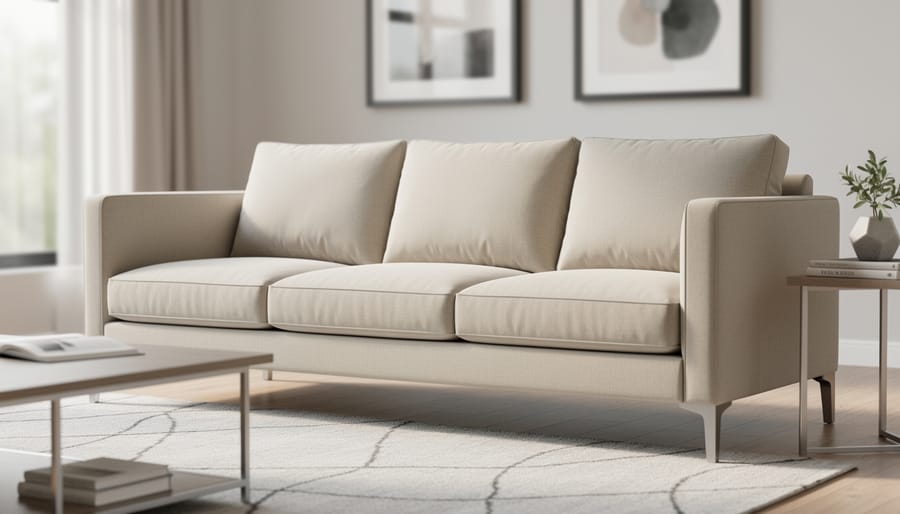
A three-cushion sofa typically measures 84 to 96 inches long, 36 to 40 inches deep, and 30 to 36 inches high. These standard dimensions comfortably seat three adults and fit most living rooms, but the right size for your space depends on room layout, traffic flow, and how you actually live in your home.
If you’ve ever wrestled a too-large sofa through a narrow doorway or watched a petite love seat disappear into a spacious great room, you know that measurements matter. But choosing the perfect three-cushion sofa isn’t just about avoiding furniture that won’t fit through your front door. It’s about creating a gathering spot that feels proportional to your space, supports how your family relaxes together, and leaves enough breathing room for everything else you love to do at home, whether that’s spreading out quilting projects, gathering friends for game night, or curling up with a good book and a cup of tea.
The challenge is that “standard” dimensions only tell part of the story. A compact 78-inch sofa works beautifully in a cozy den but might look lost anchoring a formal living room. An oversized 100-inch sectional-style three-cushion piece creates luxurious lounging space but demands careful planning to avoid overwhelming your room. And depth matters just as much as length. A shallow 32-inch depth keeps walkways clear in tight spaces, while a plush 42-inch seat invites the kind of deep, sink-in comfort that turns movie nights into cherished rituals.
This guide walks you through everything you need to know to choose confidently, from measuring your space correctly to understanding how lifestyle needs should shape your decision.
Standard 3-Cushion Sofa Dimensions Explained
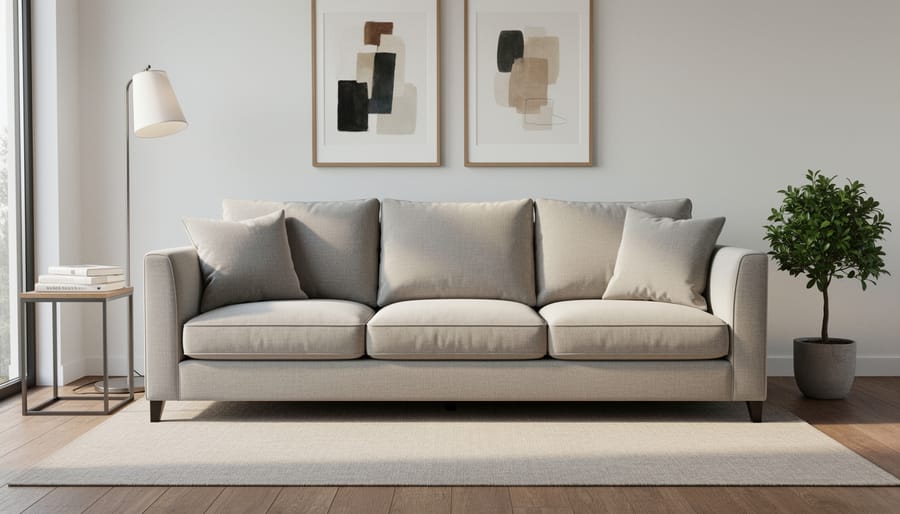
Width: The Foundation of Your Seating
The width of a three-cushion sofa typically spans 78 to 90 inches, and this measurement fundamentally shapes how your living room functions. Think of width as your seating real estate, it determines whether three adults can sit comfortably side-by-side or if someone ends up perched awkwardly on the arm.
A sofa in the 78-80 inch range works beautifully in smaller spaces but seats three people more snugly. Mid-range widths of 84-87 inches offer that sweet spot most families need: comfortable seating for three without overwhelming a standard living room. If you have the space, sofas stretching toward 90 inches provide generous room for lounging, napping, or hosting guests who actually want personal space.
Width also affects visual balance. A too-narrow sofa can look lost against a long wall, while an oversized piece may crowd your room and block natural traffic flow.
Depth: Comfort Meets Style
Sofa depth isn’t just about how far the cushion extends, it dictates whether you’ll sink into cozy relaxation or perch uncomfortably on the edge. Standard 3-cushion sofas typically measure 32 to 40 inches deep, with 35 to 37 inches being the sweet spot for most households.
Shallower depths (32-34 inches) work beautifully for formal living rooms where you sit upright during conversation, and they’re ideal if anyone in your family is petite or has shorter legs. Deeper sofas (38-40 inches) invite you to curl up with a book or stretch out for movie night, but they require good lumbar support, much like choosing proper seat comfort support for any furniture. If your feet dangle when you sit back fully, that depth is too generous for everyday use.
Height Dimensions That Matter
Overall height and seat height might seem like afterthoughts, but they profoundly affect both comfort and how your living room feels. Most 3-cushion sofas measure 30 to 36 inches tall from floor to the top of the back cushions, while seat height typically sits between 17 and 19 inches.
That seat height matters more than you’d think. Lower seats (around 17 inches) create a casual, lounge-like vibe but can be challenging for older family members or anyone with mobility concerns to rise from. Higher seats (18-19 inches) make sitting and standing easier, especially after Sunday dinner when you’re thoroughly relaxed.
Overall height influences room proportion too. In spaces with standard 8-foot ceilings, a sofa over 36 inches tall can feel imposing and visually shrink the room. Lower-profile designs open up sightlines and make cozy rooms breathe. Consider who’ll use your sofa daily and how it balances with your room’s vertical space.
Key Buying Factors for Your Perfect Fit
Measuring Your Room and Planning the Layout
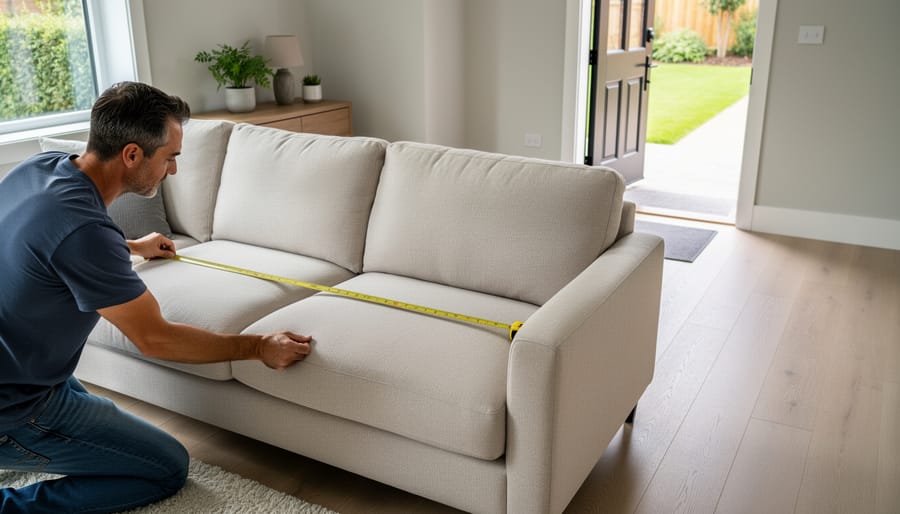
Before you fall in love with a sofa online, grab your tape measure and map out your room. Start by measuring the wall where you envision the sofa sitting, mark that spot with painter’s tape if it helps you visualize. Then measure the full length and width of your room, noting windows, doorways, and any architectural features that might affect placement.
Here’s the golden rule: leave at least 30 inches of walkway space in front of your sofa for comfortable traffic flow. If your sofa backs up to a main pathway through the room, you’ll want 36 inches or more. Picture your family actually moving through the space, carrying laundry baskets, chasing kids, or navigating with a cup of coffee. Tight squeezes get old fast.
The two-thirds rule offers a helpful starting point: your sofa’s length should be roughly two-thirds the length of the wall it sits against. An 84-inch sofa looks balanced on a 12-foot wall, while the same piece might overwhelm an 8-foot wall. When measuring for clearance account for side tables and lamps too, they’re part of your total footprint, not afterthoughts.
Doorways, Stairs, and Delivery Paths
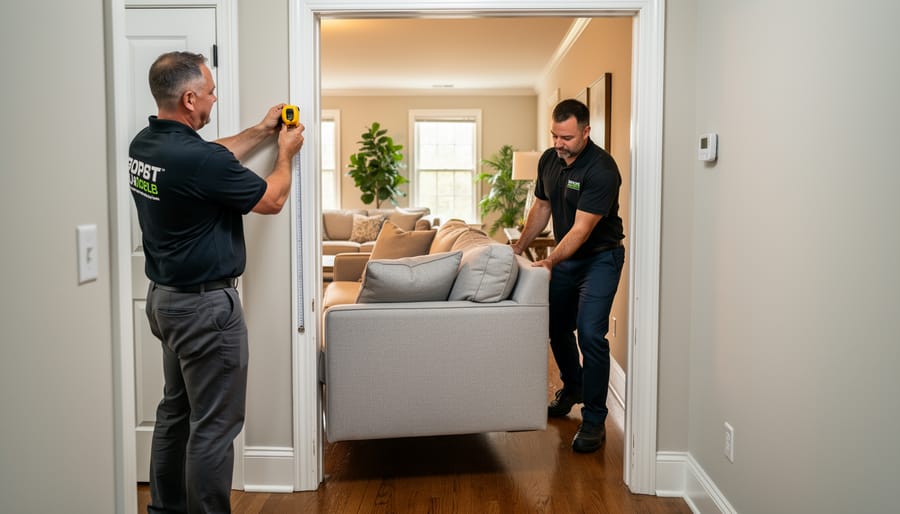
I learned this lesson the hard way when my sister ordered her dream sofa, only to watch the delivery team shake their heads at her narrow hallway. Before you fall in love with those perfect dimensions, grab your tape measure and map the journey from street to living room.
Measure every doorway, hallway, and stairwell your sofa must navigate. You’ll need at least three extra inches of clearance on each side. For tight turns, remember that delivery crews can often tilt sofas diagonally (this is where that overall height measurement becomes crucial). Measure stairwell width at the narrowest point, and don’t forget about low-hanging light fixtures.
If your building has an elevator, check the door width and interior dimensions. Some furniture companies offer sofas with removable legs or backs specifically for tricky deliveries. When in doubt, ask the retailer about their delivery team’s experience with challenging spaces, they’ve seen it all and can offer realistic assessments before you commit.
Who’s Sitting? Matching Size to Your Household
Think about who actually uses your living room on a typical Tuesday evening. Is it just you and a partner curled up with laptops? A family of five competing for prime spots during movie night? Do weekend gatherings regularly bring a crowd, or is your sofa mostly a solo reading sanctuary?
Your household’s real-life patterns should drive your dimension choices. A couple without kids might love a compact 78-inch sofa that leaves room for a reading chair and doesn’t overwhelm their space. But if you’re raising three teenagers who pile on with friends for gaming marathons, that same sofa becomes frustratingly small, you’ll want at least 84 inches to accommodate everyone without constant squabbling over cushions.
Body types matter too, though retailers rarely mention this. Taller family members (over 6 feet) need deeper seats, at least 36 inches, to avoid that knees-up perch that’s uncomfortable after ten minutes. Shorter adults and elderly relatives often prefer shallower depths around 32-34 inches, making it easier to stand without assistance.
Consider your entertaining style as well. Casual hangouts with neighbors call for generous width. Formal living rooms used mainly for holidays? You can go smaller since daily comfort isn’t the priority. Match the sofa to how you actually live, not an idealized version of your lifestyle.
Types of 3-Cushion Sofas Compared
Apartment and Compact Sofas
Apartment-sized 3-cushion sofas typically measure 72 to 80 inches wide, perfectly scaled for urban living without sacrificing the comfort of three separate seat cushions. These space-savvy designs often feature shallower depths (around 32 to 34 inches) and sleeker arms that maximize seating area without overwhelming small rooms. When shopping for a condo or studio, understanding compact sofa sizing helps you find options that fit through tight doorways and leave breathing room for coffee tables and foot traffic. Look for styles with exposed legs rather than skirted bases, they create visual lightness that makes your space feel more open, even though you’re getting full three-cushion functionality.
Standard Traditional Sofas
Standard traditional sofas hit that sweet spot of proportions that work beautifully in most homes. You’re looking at widths between 80 and 87 inches, roomy enough for three adults to sit comfortably without feeling cramped, yet sized to fit through standard doorways and work in typical living rooms without overwhelming the space.
These classic dimensions evolved for good reason. An 84-inch sofa pairs naturally with a coffee table and leaves breathing room for traffic flow in a 12-by-14-foot living room. The depth usually runs 36 to 38 inches, offering supportive comfort without the sink-in effect of deeper models. This makes traditional sofas particularly smart for households mixing different ages, grandparents can sit and stand easily while younger family members still lounge comfortably during movie night.
Oversized and Deep-Seat Sofas
If you have a generous living room and crave sink-in comfort, oversized 3-cushion sofas deliver the lounging experience many families dream about. These substantial pieces typically measure 88 to 96 inches wide and 38 to 42 inches deep, some even deeper, offering ample room for stretching out with a book or hosting movie night without anyone feeling squeezed.
The extra depth transforms how you sit. Instead of perching upright, you can truly settle back with your feet tucked under you or even nap comfortably. Families with teenagers or tall adults especially appreciate the generous proportions. Just remember that a deep-seat sofa needs a spacious room to breathe; in a smaller space, it can overwhelm the layout and make navigation awkward. If your living room is 14 by 16 feet or larger, though, an oversized sofa becomes the luxurious anchor that makes the whole space feel intentionally designed for relaxation.
How Arm Style Affects Dimensions
The arm style you choose can quietly steal or add several inches to your sofa’s usable seating area. English roll arms, with their graceful curved profiles, typically extend 6 to 8 inches per side, meaning a sofa advertised as 84 inches wide might offer only 68 inches of actual cushion space. Track arms, by contrast, are streamlined and modern, usually consuming just 4 to 5 inches per side, which translates to about 6 more inches of seating room on the same frame. Pillow-top arms fall somewhere between, at roughly 7 inches each. If you’re working with limited space or want maximum seating capacity, those seemingly small differences add up quickly. A track-arm sofa in a compact room can feel surprisingly roomy, while a chunky rolled arm might crowd the space.
How to Find Your Ideal Sofa Dimensions
Start by testing the two-thirds rule: measure your wall or seating area, then choose a sofa that fills roughly two-thirds of that length. A sofa that’s too small looks lost and fails to anchor your room, while one that’s too large overwhelms the space and disrupts flow. For an 11-foot wall, you’d want a sofa around 84-88 inches wide, leaving breathing room on both sides without creating awkward gaps.
Visit showrooms with your measurements in hand and actually sit on sofas in your target size range. Bring along household members who’ll use it most, Dad might need deeper depth than Grandma, and teen movie nights require different spacing than quiet reading evenings. Test how easily you can stand up from seated, whether your feet touch the floor comfortably, and if the back support hits you at the right height. These details matter far more than catalog photos suggest.
Create a cardboard template at home using painter’s tape to mark out the exact footprint of your prospective sofa. Live with this outline for a few days, walking around it, arranging other furniture, and noticing how it affects traffic patterns. You’ll quickly discover if you’ve left enough clearance (aim for 30-36 inches of walkway space) or if you’re constantly bumping into the taped perimeter.
Balance visual weight with function by considering your room’s other furniture. A petite loveseat paired with an oversized sofa creates awkward imbalance, while matching scale creates harmony. Your coffee table should sit 14-18 inches from the sofa edge, too close feels cramped, too far makes reaching for drinks a stretch.
Don’t forget vertical proportion. In rooms with 8-foot ceilings, a low-profile sofa (30-32 inches high) keeps sight lines open and prevents the space from feeling squat. Higher ceilings (10+ feet) can handle taller backs (34-36 inches) that add presence without overwhelming.
Take photos of furniture arrangements you love from design magazines or friends’ homes, then measure their sofas. You’ll start recognizing the proportions that appeal to you, making your own sofa fit guide decisions far more confident. Remember, the two-thirds rule serves as your starting point, but your family’s real-world comfort needs should guide the final choice.
Common Mistakes to Avoid When Sizing Your Sofa
We’ve all been there, falling in love with a beautiful sofa in a showroom or online, only to discover it overwhelms the living room or barely fits three people comfortably. One of the most common mistakes is buying a sofa that’s simply too large for the space. A 90-inch sofa might look stunning in a showroom with 20-foot ceilings, but in your 12×14 living room, it can swallow the entire space and leave you walking sideways around the coffee table. The furniture should enhance your room, not dominate it.
Another pitfall is ignoring how your sofa relates to other furniture in the room. A deep 40-inch sofa paired with a dainty side table and narrow armchair creates awkward visual imbalance. Everything should feel like it belongs to the same conversation. Similarly, many shoppers choose depth based purely on aesthetics, assuming a sleek, shallow sofa will work fine, then discover it’s uncomfortable for anyone over 5’8″ or impossible to curl up on for movie night.
Don’t forget about legroom, either. Positioning a sofa too close to a coffee table (less than 14-18 inches of clearance) makes it difficult to sit down or stand up gracefully, especially for older family members. One reader shared how her gorgeous new sofa ended up pushed against the wall because there wasn’t enough room to walk behind it, completely defeating her original open-concept vision.
Choosing the right dimensions requires patience and honest assessment of your space, but avoiding these common mistakes ensures your investment becomes the comfortable, beautiful centerpiece you envisioned.
Frequently Asked Questions
What is the average width of a 3-cushion sofa?
Most 3-cushion sofas measure between 78 and 90 inches wide, with 84 inches being a common standard size. Compact apartment models start around 72 inches, while oversized versions can extend beyond 90 inches.
How much space should I leave around my sofa?
Leave at least 30 inches of walkway space in front of the sofa for comfortable traffic flow, and 14 to 18 inches between the sofa and coffee table. For side clearances, 3 to 6 inches from walls prevents a cramped look and allows for easy cleaning.
Will a 3-cushion sofa fit through a standard doorway?
Standard doorways are typically 32 to 36 inches wide, which can be tight for sofas with large arms or high backs. Measure your sofa’s height and diagonal depth, as many sofas need to be tilted or angled to clear doorframes, and don’t forget to check hallways and stairwells along the delivery path.
What’s the best depth for sitting comfort?
For most people, a depth of 35 to 40 inches provides comfortable lounging without feeling too deep to sit upright. If you’re shorter or prefer firm back support, stick with 32 to 36 inches; taller folks or nappers often appreciate depths of 40 inches or more.
How do I know if a sofa is too big for my room?
If your sofa takes up more than two-thirds of your wall length or forces you to squeeze through narrow walkways, it’s likely too large. Stand in the room and visualize the sofa in place, you should still have breathing room for side chairs, tables, and easy movement around the space.
These questions come up again and again when families are narrowing down their choices, and I’ve found that having clear answers helps you shop with confidence. One reader told me she’d been hesitating between two models for weeks until she measured her doorway and realized the sofa she loved wouldn’t make the turn into her living room. That’s the kind of heartbreak you can avoid by getting these details sorted early.
The beauty of understanding these fundamentals is that you can walk into any showroom or browse online with a clear picture of what’ll work in your home. You’re not just guessing or hoping, you know your numbers, you’ve thought through how your family actually uses the space, and you can make a choice that serves you well for years to come.
Choosing the right 3-cushion sofa dimensions isn’t just about fitting furniture into a room, it’s about creating a space where your family naturally gathers, where conversations flow easily, and where everyone feels truly comfortable. Take your time with measurements. Walk through your home with a tape measure in hand. Picture your family curled up for movie night, hosting friends for game day, or simply unwinding after a long week.
If you can, visit showrooms and actually sit on sofas in your target size range. Lean back. Stretch out. Notice how the depth feels for your height, whether the seat height makes standing easy, and if the proportions just feel right. Photos online can’t tell you these things.
The perfect sofa becomes the heart of your home, the spot where memories unfold and daily life happens. When you choose dimensions that truly work for your space and lifestyle, you’re not just buying furniture. You’re investing in countless cozy evenings, animated family discussions, and the comfortable gathering place your home deserves. Trust your measurements, trust your instincts, and enjoy the transformation.